

The “Golden Hour”: Why Prompt Trauma Care After an Accident is Critical
October 30, 2025
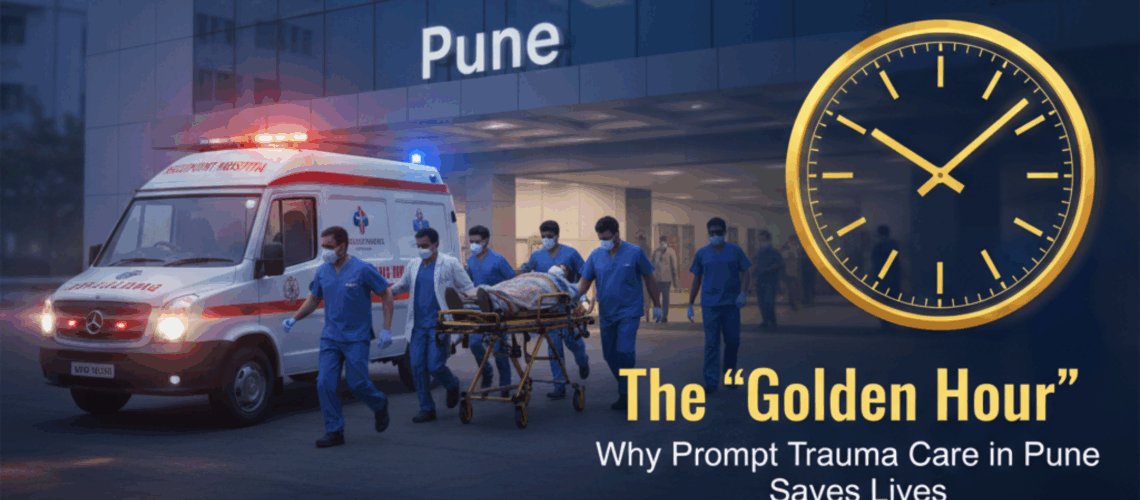
In the chaotic aftermath of a severe accident, perhaps on Pune’s busy roads, every second ticks by with immense weight. You may have heard medical professionals and emergency responders talk about the “Golden Hour.” This isn’t just a dramatic phrase; it’s a critical concept in emergency medicine that directly impacts a patient’s chance of survival. Understanding this window of time highlights the absolute necessity of receiving prompt trauma care.
What Exactly is the “Golden Hour”?
The “Golden Hour” refers to the crucial period of time immediately following a traumatic injury. While not always a literal 60 minutes, it represents the window where the highest likelihood of a positive outcome exists if a patient receives definitive medical intervention.
This concept was first popularized by Dr. R Adams Cowley, a military surgeon who observed that the sooner he could operate on critically injured soldiers, the better their chances of survival. This principle applies directly to civilian emergencies like car accidents, severe falls, or industrial injuries. During this initial period, the body is fighting to compensate for the shock and damage it has sustained. However, this compensatory state is temporary. Without intervention, the body will begin to fail, leading to irreversible damage or death.
Why This Period is So Critical
When a person suffers a major trauma, the body’s response is immediate and complex. The most life-threatening issues are often internal: severe bleeding (hemorrhage), compromised airway, brain swelling, or a collapsed lung.
Initially, the body attempts to cope. The heart rate may increase to maintain blood pressure despite blood loss, and breathing may quicken to increase oxygen intake. But these mechanisms can only last so long.
Without prompt trauma care, a patient can rapidly decompensate. Uncontrolled internal bleeding can lead to hemorrhagic shock, a state where the organs are starved of oxygenated blood. A blocked airway can lead to brain damage in just minutes. This is why time is the enemy. The interventions provided during the Golden Hour are designed to halt this downward spiral before it becomes irreversible.
The Life-Saving Role of Prompt Trauma Care
Receiving prompt trauma care at a well-equipped facility is about more than just stopping the bleeding. It’s about a coordinated, rapid-response effort from a multi-disciplinary team.
When a trauma patient arrives at a hospital, the team’s first priority is a rapid assessment, often called the “primary survey.” This involves:
- Airway: Is the airway clear?
- Breathing: Is the patient breathing effectively?
- Circulation: Is there a pulse? Is there major bleeding?
- Disability: What is the patient’s neurological status?
- Exposure: Are there other injuries?
Based on this assessment, life-saving interventions begin immediately. This can include securing an airway, inserting chest tubes to re-inflate a lung, administering IV fluids or blood transfusions to combat shock, and controlling external and internal bleeding. This seamless chain of survival is what makes prompt trauma care so effective.
Meeting the “Golden Hour” Challenge in Pune
For residents of Pune, knowing where to turn for prompt trauma care is a critical part of emergency preparedness. This is where Medipoint Hospital steps in. Our dedicated Accident & Orthopedics department is built to handle the pressures of the “Golden Hour.”
Located in Chandan Nagar–Kharadi, Medipoint Hospital is equipped with 24/7 emergency services, an advanced on-site diagnostic center, and immediate access to specialists in general surgery and orthopedics. Our team is trained to perform the rapid assessments (Airway, Breathing, Circulation) and life-saving interventions required to stabilize a patient. For the Pune community, this means that expert prompt trauma care is accessible and ready, ensuring that the precious minutes of the Golden Hour are used to their fullest, life-saving potential.
Your Takeaway: Don’t Wait
The “Golden Hour” underscores a simple, vital truth: in a medical emergency, time is life. The difference between a full recovery, permanent disability, or death often hinges on the speed and quality of care received. If you or someone else is involved in a serious accident in or around Pune, the most important action you can take is to call for emergency help immediately and get to a hospital equipped to handle trauma. Your decisiveness in seeking prompt trauma care can make all the difference.